Best Manager Ever
- 1. You are on time for meetings
- 2. You are prepared for meetings
- 3. You address people by name
- 4. You pay attention (active listening)
- 5. You say no to requests that don’t bring value to the project
- 6. You don’t do charity - no unpaid extra hours, no work that’s not pertinent to the project
- 7. You don’t commit to anything on the spot - you follow up later
- 8. You always follow up. And if you don’t hear back you follow up repeatedly
- 9. You deliver something at every interaction
- 10. You take your work seriously
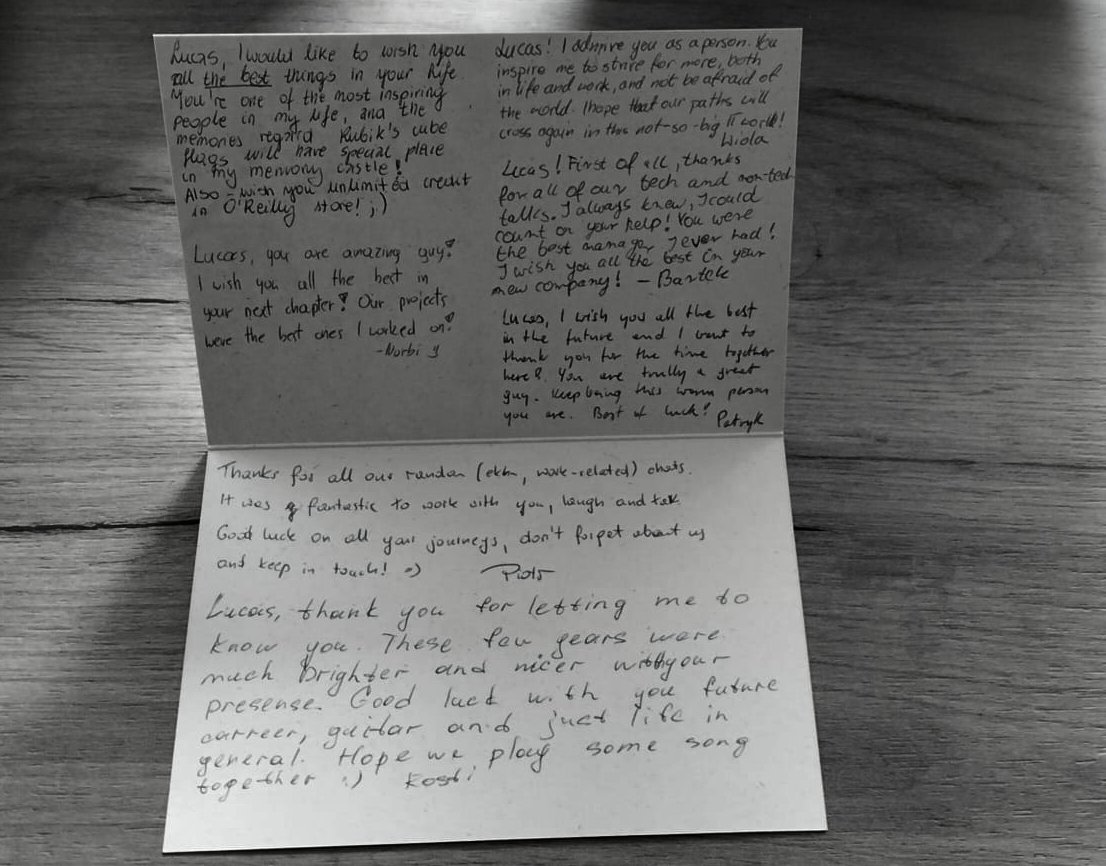
This week I’m changing jobs. My previous team was fantastic, and I’m really grateful for having had the opportunity to meet so many talented people. This week I got to hear very nice words about my work. Instead of a bragfest, I will discuss the things I believe make a colleague worthy of those compliments.
So, for another non-technical post, I had this list of things I thought were important behaviors to have.
1. You are on time for meetings
This feels silly, but wasting people’s time is disrespectful. When you get that Outlook snooze, join the meeting. Your audio should always work, don’t be the “can you hear me” person. Your camera should be always on. If you’re expected to be sharing your screen on the meeting you better have it ready to go.
2. You are prepared for meetings
If it’s a scrum meeting, you have already prepared ahead of what you’re gonna say. If it’s a catch up, you know what you’re updating the other person on. Planning meetings are quick because you have already written acceptance criteria and estimations for your stories. If you’re collaborating on a document, everyone who’s expected to read/write it already has permission beforehand. Like the previous.
3. You address people by name
Straightforward one, but hard to get right. I personally keep notes on people’s names and roles, and practice until I get it right.
If you ever mispronounce or misspell someone’s name, you publicly apologize and make it right. If someone does that to you correct them on the spot, don’t let it slide. Your name is a very important part of social interactions, especially at work.
4. You pay attention (active listening)
When you are in a meeting, listen carefully. Take notes often. Don’t outsource your notes. Don’t summarize transcripts. If you’ve agreed to donate your time to people, and commit to the time you’re giving them.
Who was in the meeting? What are their roles? What was discussed? What was not discussed? If you might forget what was said, having something to refer to is often very, very important. Your team will be grateful for it.
5. You say no to requests that don’t bring value to the project
Another self-explanatory point, but an important one. I personally have a hard time saying no, so I have a trick for this one. I call it the “backlog limbo”. I disguise non-critical tasks under some nice name like “blue sky” and file those tasks there. Keep in mind this is not something you want to do with technical debt. Keep those separate.
6. You don’t do charity - no unpaid extra hours, no work that’s not pertinent to the project
The will of employees to keep their customers happy has a line. And you have to know where that line is, and not to cross it. This point may not be well received in non-european cultures, but I believe even Americans or Asians appreciate an employee who gets everything done in time, packs his things and goes home to his life.
Don’t work for free, unless you have something to gain from it. This is not being selfish. There’s a time and place for charity, and work is not it.
7. You don’t commit to anything on the spot - you follow up later
It is very normal to ask for a commitment from someone, and we have a natural instinct to make that pact. But our word needs to have value, and if you commit to something without giving it the right amount of thought, there’s little chance you’ll meet the bargain.
Say you will get back after the meeting, iron out the details, and get back to them. Make conservative estimations, might want to multiply your estimations by 1.5 for good measure. If you have a hard deadline, reduce the scope to something you are sure you can deliver. Then, deliver more than you committed to.
8. You always follow up. And if you don’t hear back you follow up repeatedly
I might be jaded by working for traditional financial institutions with v-e-r-y slow processes and resigned employees. I would go as far as saying many companies have lazy, almost adversarial IT employees and policies. I think this topic warrants its own post some day.
Here’s a test: if your employees don’t have the tools they need to do their job on day one, you failed. If they need to self-service-request those things, they need to know what those are. And if the one approver to those is not their manager, you failed again.
Be it as it may, we peasants normally can’t change an organization. What we can do though, is keep pushing. Don’t allow yourself to be ignored. Don’t allow yourself to be ghosted. Keep following up. Escalate. Get the root of the issue. Everyone will benefit from it, who knows, you may even end up solving an underlying issue.
9. You deliver something at every interaction
Every meeting you have calls for you to show who you are. Use your voice, know the context of the meeting, know the people, and say what you have to say. In the best case you’re showcasing some great work you did, asking clarifying questions, or answering questions with your expertise is also very important.
As a line manager I always made sure to bring people, at a minimum, company updates. Always asked how people were, and what they were working on. Always offered my help in case they needed it. This may seem trivial, but if you’re doing this consistently over a 2-year period, you build relationships based on trust, not on power.
Beware though, don’t talk about things in progress as if they were ready. If you are delivering something, you should be able to show it live. And you definitely should be showing the things you did.
10. You take your work seriously
Here’s the harsh reality. Having the right attitude is not enough. A director with the right attitude that doesn’t get things done is extremely toxic to a department. If you’re telling people that you’re having tons of “organization and planning” sessions to fix things, and after two years nothing has changed, I’m sorry but you failed.
The road to hell is paved with good intentions. So, put your money where your mouth is, and deliver on what you planned.